
2024
Hackathon Project
⚡Background
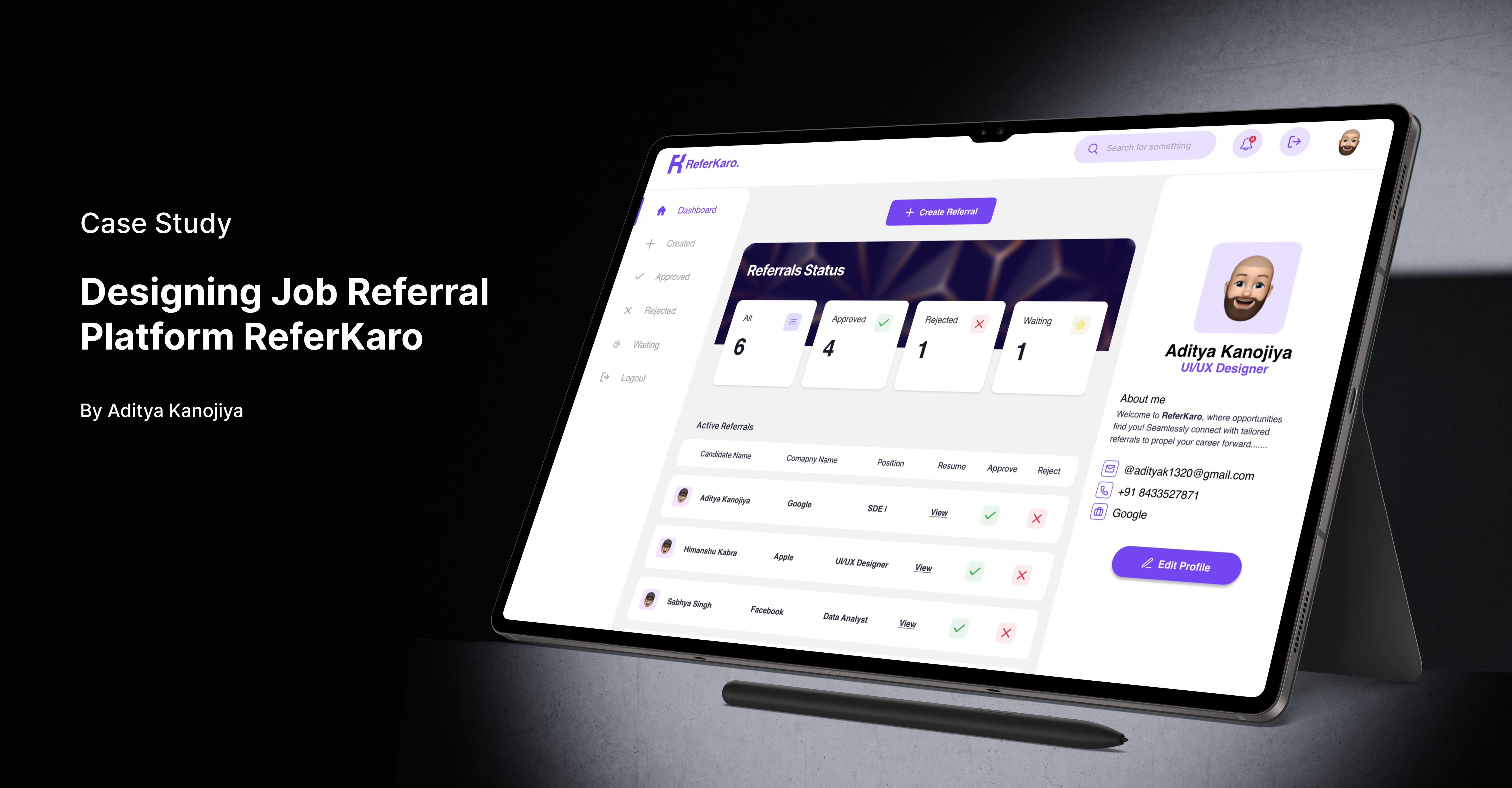
Referkaro is a web-based platform designed to simplify the employee referral process in hiring. It connects job seekers with opportunities posted by employees working in companies, enabling a transparent and structured referral workflow. The goal was to build a product that bridges the gap between candidates looking for referrals and employees willing to provide them, while ensuring trust, usability, and smooth interaction.
The platform provides dashboards for both employees and candidates, supports referral tracking, and enables clear communication around job postings.
🚨Problem Statement
The existing job referral process is fragmented and inefficient:
Job seekers rely on cold LinkedIn DMs or personal networks, which often go unanswered.
Candidates struggle to find employees willing to give referrals.
Employees have limited structured ways to share referral opportunities.
Employees face spam from irrelevant requests.
No centralized system exists to track, verify, and manage referral requests.
Lack of trust between seekers and referrers slows the process.
Companies miss out on leveraging referral-based hiring at scale.
Referkaro was envisioned to create a dedicated ecosystem that connects employees and job seekers with a structured, transparent, and user-friendly workflow.
📊User Research & Discovery
Primary Research:
Job seekers want authentic referral access and real-time updates.
Employees want a secure, streamlined way to share and manage referrals without being spammed.
Both groups highlighted trust and credibility as the biggest gaps in existing processes.
Secondary Research:
85% of jobs are filled via networking or referrals, yet there are no mainstream platforms exclusively for referrals.
Referral hires are 55% faster and 25% cheaper to onboard compared to traditional hires.
🎯Design Goals
Build a centralized referral marketplace.
Provide simple flows for both job seekers and employees.
Create trust-building features like verified employee profiles.
Enable transparent tracking of requests and responses.
Deliver a minimal, professional UI that aligns with career-focused use cases.
🧭Design Process
The design followed a user-centered approach:
Information Architecture: Two main user roles (Employee & Job Seeker). Flows mapped for posting, requesting, and managing referrals.
Wireframing: Focused on simplifying navigation: Dashboard → Job Listings → Referral Request → Updates.
Visual Design: Clean, modern interface with professional typography, muted colors, and trust-oriented layout.
Prototyping: Built interactive flows in Figma for both user roles, tested with small focus groups.
🎨Solution & Final Design
Landing Page: Clear positioning of Referkaro as a “Referrals-first job platform.”
Dashboard: Personalized views for employees (referral requests) and job seekers (referral opportunities).
Job Listings & Referral Requests: Simple interface to apply for referrals directly.
Verification Layer: Employees marked as “Verified Referrers” to build credibility.
Notifications: Real-time updates on referral status.
Profile: Stores experience, referral history, and credibility score.

✅Results and Impact
Since Referkaro was designed as a hackathon project, the focus was on validating the problem space and demonstrating business potential rather than launching a live product.
Business Validation: The concept addressed a real gap—centralized, trust-based referrals—which resonated strongly with judges and participants.
User Validation: Feedback from job seekers and employees during the hackathon highlighted the value of verified referrers and real-time referral tracking.
Efficiency Impact: The proposed flows showed potential to cut referral turnaround time by 40–50% compared to traditional networking.
Pitch Outcome: The project was recognized for tackling a high-impact hiring challenge and demonstrated how referrals could scale beyond informal networks.
📚Learnings
Job seekers value transparency and speed above everything else.
Employees appreciate structured referral management to avoid being overwhelmed.
A neutral platform (not tied to LinkedIn) creates comfort for both sides.